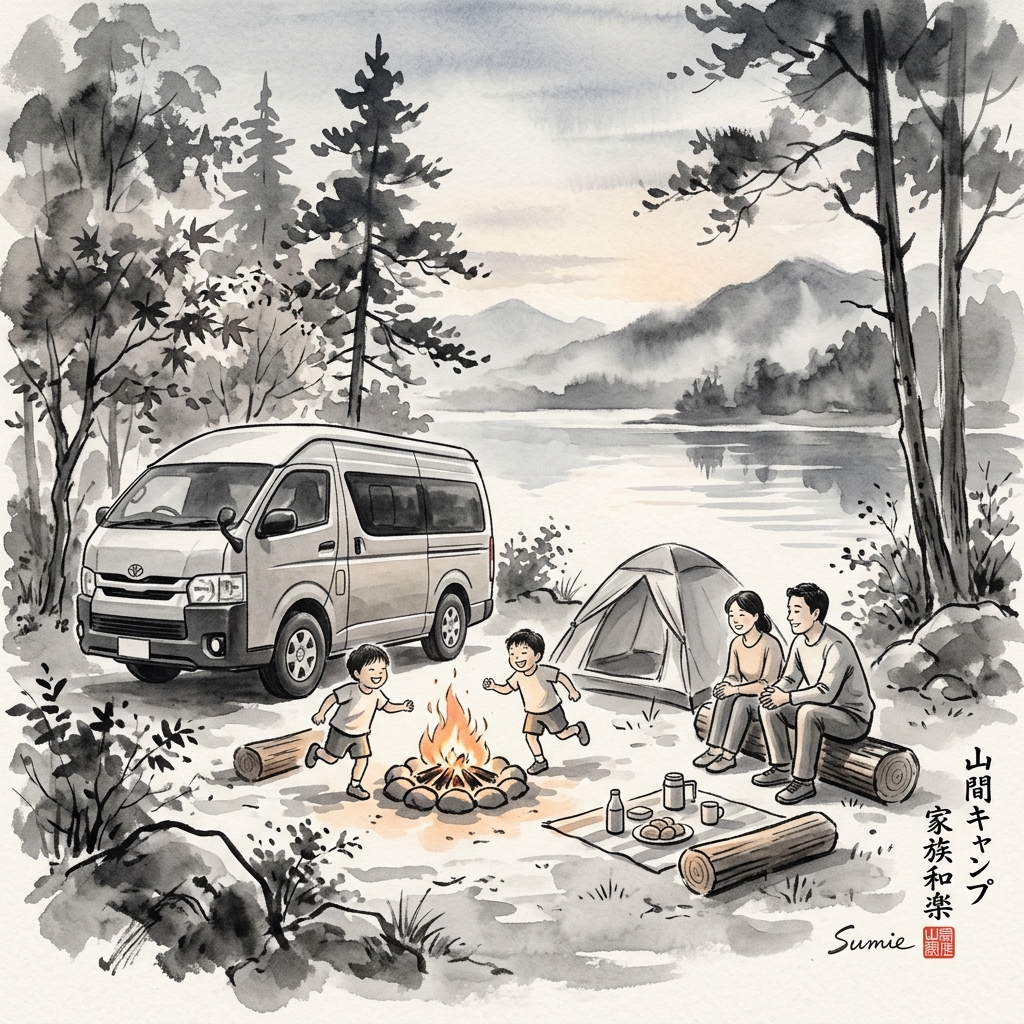
If you have ever driven through the Japanese countryside, you have almost certainly noticed the distinctive brown signs with a stylized house icon pointing you toward a "道の駅": a Michi-no-Eki, or roadside station. There are over 1,200 of these stations scattered across Japan, and Kyushu alone boasts more than 130. For campervan travelers, they represent something far more valuable than a simple rest stop. They are, in many ways, the infrastructure that makes van life in Japan genuinely comfortable rather than merely possible.
Each Michi-no-Eki is operated by the local municipality and offers, at minimum, free parking, clean restrooms open around the clock, and some form of local information center. But the best ones go far beyond these basics. Some feature full-scale onsen hot spring baths. Others house gourmet restaurants serving hyper-local cuisine that you will not find anywhere else. Many operate farmers' markets where the produce was harvested that same morning, at prices that would make a Tokyo supermarket blush.
⚠️ Important Notice Regarding Overnight Parking
Michi-no-Eki are designated as rest facilities, not campgrounds. Overnight parking policies vary by station. Some stations explicitly permit it, while others prohibit overnight stays entirely. Rules can change at any time based on local government decisions.
Always check the posted signage at each station before parking overnight. Look for signs such as 「車中泊禁止」(overnight parking prohibited) or 「仮眠OK」(napping permitted). If you are unsure, ask the information center staff during business hours.
VanTripJapan does not encourage or endorse overnight parking at any Michi-no-Eki where it is not explicitly allowed. This guide is provided for informational purposes only. We recommend using designated campgrounds and RV parks as your primary accommodation. The stations listed below are highlighted for their daytime amenities (local food, hot springs, and scenic locations), which make them excellent rest stops during your Kyushu road trip.
If you do rest at a station that permits it, please follow these basic courtesies: keep everything inside your vehicle, maintain quiet hours (especially after 9 PM), clean up thoroughly, and depart by mid-morning. Treating each station with respect ensures they remain welcoming for all travelers.
1. Michi-no-Eki Aso (道の駅 阿蘇) in Aso, Kumamoto
Positioned at the foot of Mount Aso, one of the world's largest active calderas, this station is the perfect base camp for exploring Kyushu's most dramatic volcanic landscape. The station sits along National Route 57 in the town of Aso, offering panoramic views of the surrounding grasslands known as Kusasenri.
The highlight for campervan travelers is the large, flat parking area that comfortably accommodates vehicles of all sizes, including the larger hi-ace and bongo-style campervans common in Japan. The adjacent information center provides excellent English-language maps of the Aso caldera hiking trails, and the staff can advise on current volcanic activity levels and road closures.
The on-site market is exceptional. Aso is renowned for its dairy farming, and the rich volcanic soil produces some of Japan's finest grass-fed beef and raw milk products. Pick up fresh Aso milk, locally made cheese, and aka-ushi (red beef) products at prices significantly below what you would pay at tourist restaurants. The soft-serve ice cream made from Aso milk is legendary among Japanese road trippers.
Practical information: 24-hour restrooms. Market and food stalls open 9:00–18:00. The nearest onsen is Aso Farm Land (approximately 15 minutes by car), which offers day-use bathing. GPS coordinates: 32.9481° N, 131.0896° E.
2. Michi-no-Eki Yufuin (道の駅 ゆふいん) in Yufu, Oita
Located just off the Yufuin Interchange on the Oita Expressway, this station provides easy access to one of Japan's most elegant hot spring towns without the hassle of navigating Yufuin's notoriously narrow downtown streets in a campervan.
The station itself is compact but well-maintained, with a lovely view of Mount Yufu (also known as Bungo Fuji for its distinctive conical shape). The produce market here specializes in Oita Prefecture's famous kabosu citrus, a tart, aromatic fruit used as a condiment throughout Kyushu. During autumn, you will find kabosu by the bagful at remarkably low prices, along with dried shiitake mushrooms that Oita is famous for producing.
What makes this station particularly valuable for campervan travelers is its strategic position. From here, you are within a 10-minute drive of Yufuin Onsen's main street (Yunotsubo Kaido), where you can park at a public lot and explore on foot. You are also at the starting point of the Yamanami Highway, one of Japan's most spectacular mountain driving routes that winds through the volcanic highlands toward Aso.
Practical information: 24-hour restrooms. Market open 9:00–17:00. Several public onsen in Yufuin town center within 10 minutes. GPS coordinates: 33.2755° N, 131.3711° E.
3. Michi-no-Eki Taketa (道の駅 竹田) in Taketa, Oita
Taketa is one of Kyushu's most underrated destinations, a castle town that most international tourists overlook entirely. The Michi-no-Eki here is a gem for precisely this reason: it is quiet, spacious, and surrounded by genuine rural Japan rather than tourist crowds.
There is no bath at the station itself. What it has is a farm market, a dining room serving vegetable curry, and a strawberry farm next door where you can pick your own from about December to May. For a soak, Taketa city has hot springs of its own, including the carbonated baths of Nagayu Onsen.
The town of Taketa itself is worth a morning's exploration. The ruins of Oka Castle (岡城跡), perched on a dramatic cliff edge, inspired the famous Japanese song "Kōjō no Tsuki" (Moon over the Ruined Castle). The stone walls are atmospheric and largely deserted compared to more famous castle sites.
Practical information: 24-hour restrooms. The market and dining room are open 9:00-17:00 and close over the New Year holidays. GPS coordinates: 32.9855° N, 131.3405° E.
4. Michi-no-Eki Kitagawa Hayuma (道の駅 北川はゆま) in Nobeoka, Miyazaki
Kitagawa Hayuma sits right off the Kitagawa exit of the Higashi-Kyushu Expressway and can also be reached from National Route 10, about 11 km north of central Nobeoka. That makes it a convenient stop for campervan travelers driving the eastern Kyushu coast between Oita and Miyazaki City. The name comes from hayuma, the old word for the post horses of Japan's relay stations some 1,300 years ago.
The station occupies an elevated position overlooking the Kitagawa River valley, and the parking area is spacious and well-lit. The restrooms are modern and immaculately maintained, a characteristic of Miyazaki Prefecture's roadside stations in general. Check posted signs for the station's current parking policy before planning an extended stop.
The food counter here serves exceptional Miyazaki chicken nanban, the crispy fried chicken topped with rich tartar sauce that is Miyazaki Prefecture's signature dish. The market section sells local fruits, including Miyazaki mangoes in season.
Practical information: 24-hour restrooms. The shop and takeout counter are open 8:30-18:00 and the restaurant 11:00-17:00 (last orders). Coin-operated showers are available. GPS coordinates: 32.6661° N, 131.7047° E.
5. Michi-no-Eki Tarumizu Hamabira (道の駅 たるみずはまびら) in Tarumizu, Kagoshima
No Michi-no-Eki in Kyushu has a more dramatic setting. Perched on the shore of Kinko Bay on the Osumi Peninsula, the station offers an unobstructed view of Sakurajima, Kagoshima's iconic active volcano, rising directly across the water. On clear days, you can watch volcanic plumes drifting from the crater while eating breakfast in your van.
The building is modern, with a deck over the bay, and Marine Park Tarumizu is right next door. The parking lot is large and flat, offering an excellent daytime rest stop with a view that rivals any paid campground in the region. As always, check posted signage regarding overnight parking rules.
The local specialty here is kanpachi (greater amberjack), a sashimi-grade fish farmed in Kagoshima's clean coastal waters. The station restaurant serves kanpachi donburi (rice bowls) that are absurdly fresh. The market also sells Tarumizu's famous mandarin oranges and sweet potatoes, which Kagoshima produces in greater quantity than any other prefecture in Japan.
Practical information: 24-hour restrooms. The station is open 9:00-18:30 and the restaurant from 11:00 (until 19:00 on weekdays, 20:00 at weekends). There is no bath here; for a soak, drive about 20 minutes north on Route 220 to Michi-no-Eki Tarumizu, which has a natural hot spring and a 60-meter foot bath. GPS coordinates: 31.4684° N, 130.6983° E.
6. Michi-no-Eki Ureshino Maruku (道の駅 うれしの まるく) in Ureshino, Saga
Ureshino is one of Kyushu's oldest and most celebrated hot spring towns, and its Michi-no-Eki reflects this heritage beautifully. The station stands in front of Ureshino-Onsen Station on the Nishi-Kyushu Shinkansen, along National Route 34, and serves as a gateway to a town where the hot spring water is so mineral-rich that it is classified as "bihada no yu", or literally "beautiful skin water."
The station has free foot and hand baths fed straight from Ureshino's hot spring source and open 8:00 to 23:00, so you can soak your feet after a long drive. Ureshino is also one of Japan's tea towns, and the information building sells local tea, including the curly tamaryokucha Ureshino is known for, along with local sweets.
The onsen town is a five-minute drive away, with public bathhouses (共同浴場) that include the elegant Siebold no Yu, named after the German physician Philipp Franz von Siebold who visited Ureshino in the 1820s and documented its healing properties. Day-use bathing at these facilities typically costs between ¥400 and ¥700.
Practical information: 24-hour restrooms. The information building is open 9:00-19:00 and the free foot and hand baths 8:00-23:00. The onsen town is five minutes away by car. GPS coordinates: 33.1064° N, 129.9979° E.
7. Michi-no-Eki Imari (道の駅 伊万里) in Imari, Saga
The final station on our list brings you to the heartland of Japanese porcelain. Imari, along with neighboring Arita, has been producing some of the world's finest ceramics for over 400 years, a tradition that began when Korean potters brought their techniques to this corner of Kyushu in the early 17th century.
The Michi-no-Eki Imari sits along National Route 202 and features a surprisingly sophisticated shopping area where you can purchase Imari-yaki and Arita-yaki porcelain at factory-direct prices. For campervan travelers who appreciate craftsmanship, this is an opportunity to acquire genuine artisan ceramics (bowls, plates, cups, and sake sets) at a fraction of department store prices. Many pieces are sold as "seconds" with imperceptible flaws that reduce the price by 50 percent or more.
The food offerings here center around Imari beef, one of Kyushu's premium wagyu brands that remains relatively unknown outside Japan. The station restaurant serves Imari beef hamburger steaks and curry that represent extraordinary value. The market also stocks Imari pears (a local specialty in autumn) and locally produced soy sauce and miso.
From Imari, it is a pleasant 30-minute drive to the historic pottery town of Arita, and about 45 minutes to Sasebo and the Kujūkushima (Ninety-Nine Islands) coastline. That makes this an excellent daytime base for exploring northwestern Kyushu.
Practical information: 24-hour restrooms. Market and shops open 9:00–18:00. The nearest onsen is Imari Onsen (approximately 10 minutes). GPS coordinates: 33.2649° N, 129.8783° E.
Essential Michi-no-Eki Etiquette for Campervan Travelers
To ensure that Michi-no-Eki remain welcoming to campervan travelers, please observe the following guidelines that are considered standard practice throughout Japan:
- Keep everything inside your vehicle. Do not set up chairs, tables, awnings, or any equipment outside your van. This is the single most important rule.
- Minimize noise after 9:00 PM. Keep your radio, conversations, and engine use to an absolute minimum. Many stations are located near residential areas.
- Depart by mid-morning. While there is no strict checkout time, lingering past 10:00 AM with a clearly "camped" vehicle is considered poor form.
- Do not drain grey water. Never drain sink water, cooking water, or any liquid waste in the parking lot or restrooms. Use designated dump stations at campgrounds.
- Purchase something from the station. This is not a rule, but it is good karma. These stations are operated by local communities, and your patronage supports rural economies that depend on traveler traffic.
- Separate your trash. Japan's waste separation rules apply at Michi-no-Eki. Use the designated bins and sort your waste into burnable, non-burnable, PET bottles, and cans.
Planning Your Michi-no-Eki Route
The seven stations listed above can be connected into a natural loop around Kyushu. Start from Fukuoka and head south through Saga (Ureshino and Imari), then east to Kumamoto (Aso), north to Oita (Taketa and Yufuin), south down the coast through Miyazaki (Nobeoka), and finally to Kagoshima (Tarumizu) before returning north. That gives you the skeleton of a comprehensive 7-to-10-day Kyushu road trip with excellent rest stops at every stage. For overnight accommodation, we recommend nearby campgrounds and RV parks.
Japan's Michi-no-Eki system is one of the most remarkable pieces of travel infrastructure in the world. Nowhere else will you find a government-maintained network of free rest stops where you can soak in volcanic hot springs, eat freshly caught sashimi, buy artisan ceramics, and recharge before continuing your journey. For campervan travelers, Kyushu's Michi-no-Eki are worth planning a day around. Pair them with designated campgrounds for your overnight stays, and you have the backbone of a good road trip.